Epitope-Conditioned Antibody Generation

REACH-Ab

Preparing structure view...

Mechanism Figures

How REACH-Ab turns epitope guidance into evolving interface relations

These figures summarize the scientific story behind the viewer: REACH-Ab first defines the antibody design task at the complex level, then maintains candidate epitope-paratope relations as dynamic states, and finally feeds selected relation states back into local message passing.

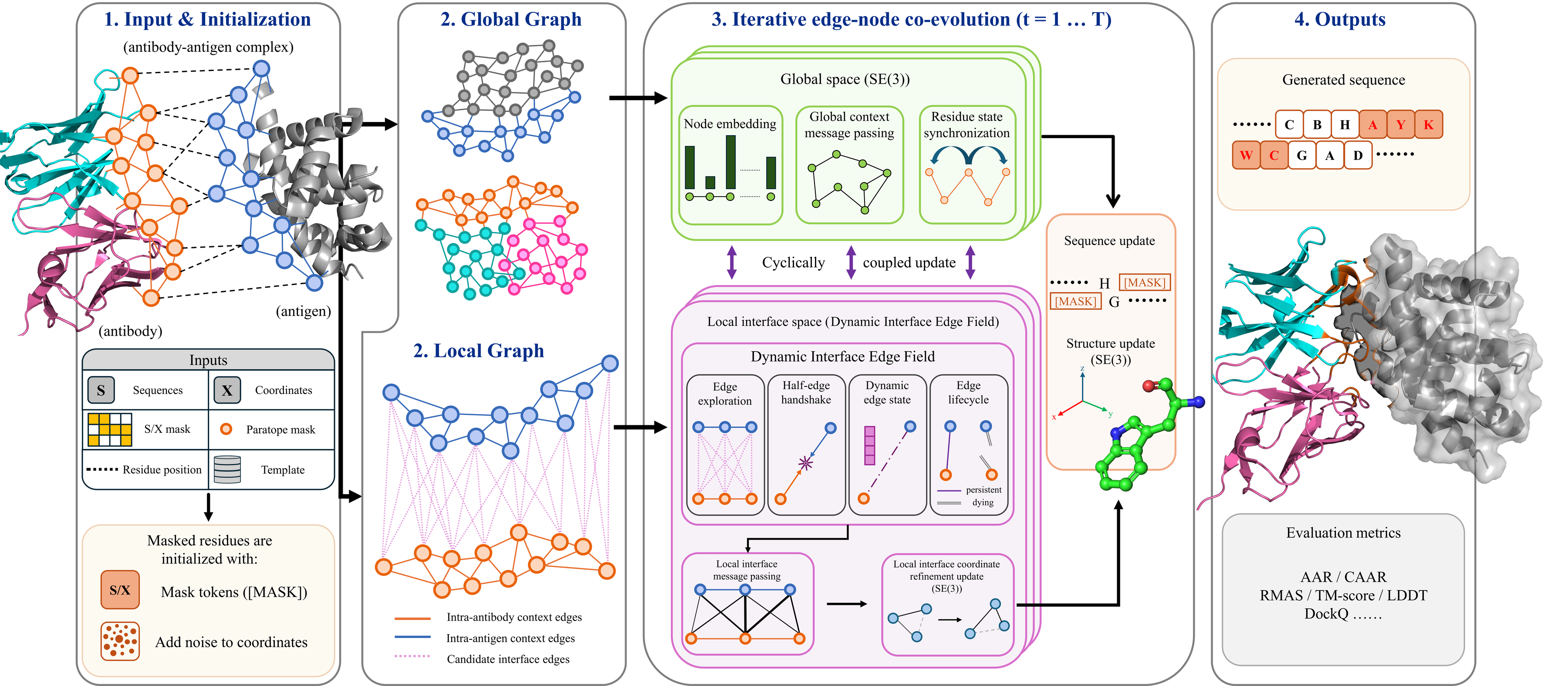
Framework of REACH-Ab with input initialization, global graph, local graph, iterative edge-node co-evolution, and outputs

Framework Overview

From masked CDR residues to generated antibody sequence and complex structure

The framework initializes masked CDR residues from an antibody-antigen complex, builds global and local graphs, and iteratively couples SE(3) message passing with a local Dynamic Interface Edge Field. The key idea is that candidate interface edges are explored, updated, and selected before they guide local coordinate refinement and sequence generation.

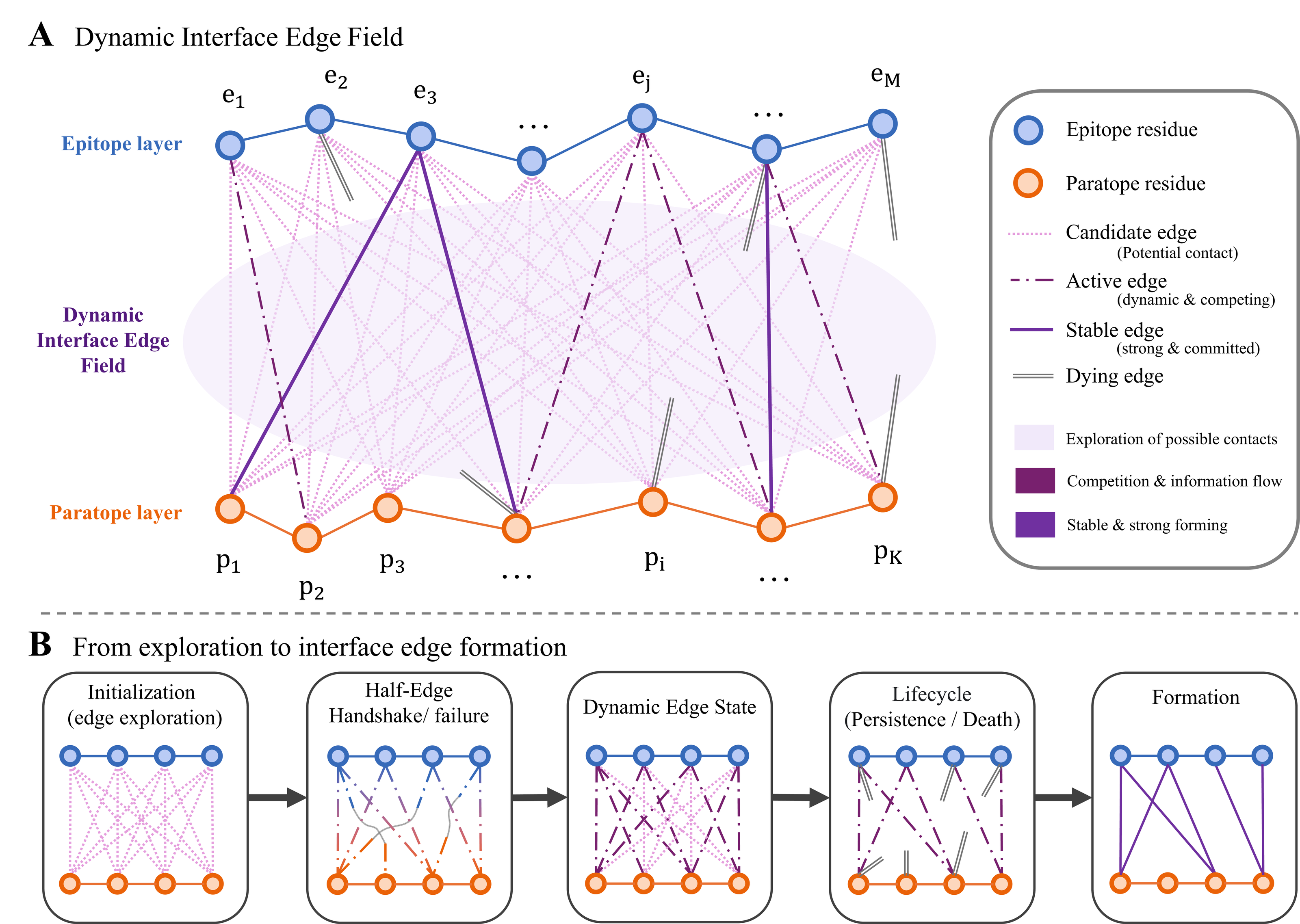
Schematic of the Dynamic Interface Edge Field moving from candidate edge exploration to stable interface edge formation

Core Concept

A dense relation field becomes a sparse active interface graph

REACH-Ab maintains many possible epitope-paratope contacts instead of committing only to current geometric neighbors. During refinement, half-edge evidence and lifecycle control let some relations stabilize, some compete, and some die out. This is the mechanism that reduces epitope guidance lag: antigen-facing contact hypotheses remain available before the paratope geometry is fully reliable.

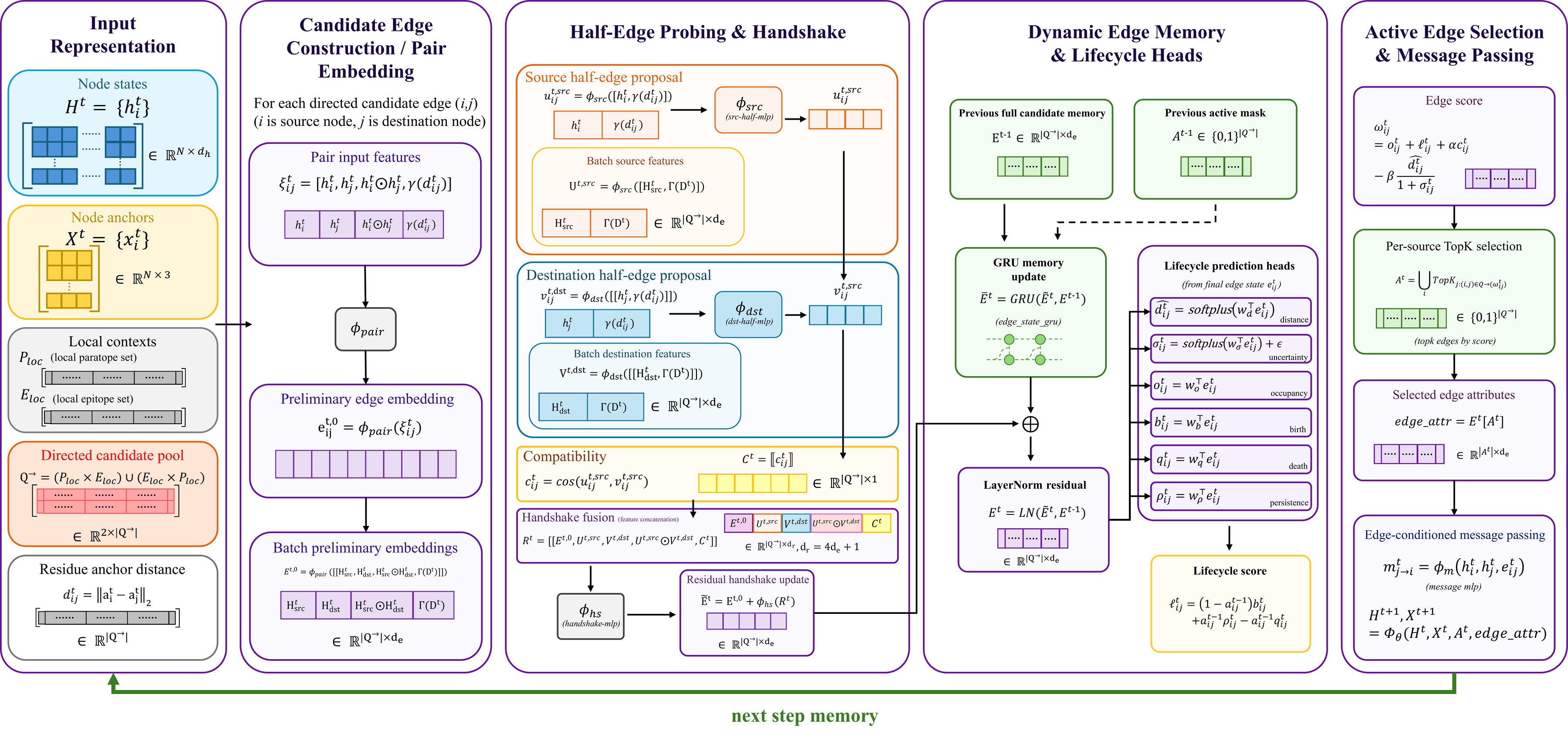
Detailed implementation flow of candidate edge construction, half-edge probing, dynamic memory, lifecycle heads, active edge selection, and message passing

Implementation Flow

Candidate edges carry memory, compatibility, uncertainty, and lifecycle signals

At each refinement step, residue states and anchors construct a directed candidate edge pool. Pair-level features are updated through source-side and destination-side half-edge probing, then fused into persistent edge memory. Distance, occupancy, birth, death, persistence, and uncertainty heads produce an active edge score; selected edge states then become attributes in local message passing and are carried to the next refinement step.

Edge-Field-Guided Generation

Watching contact hypotheses form during generation

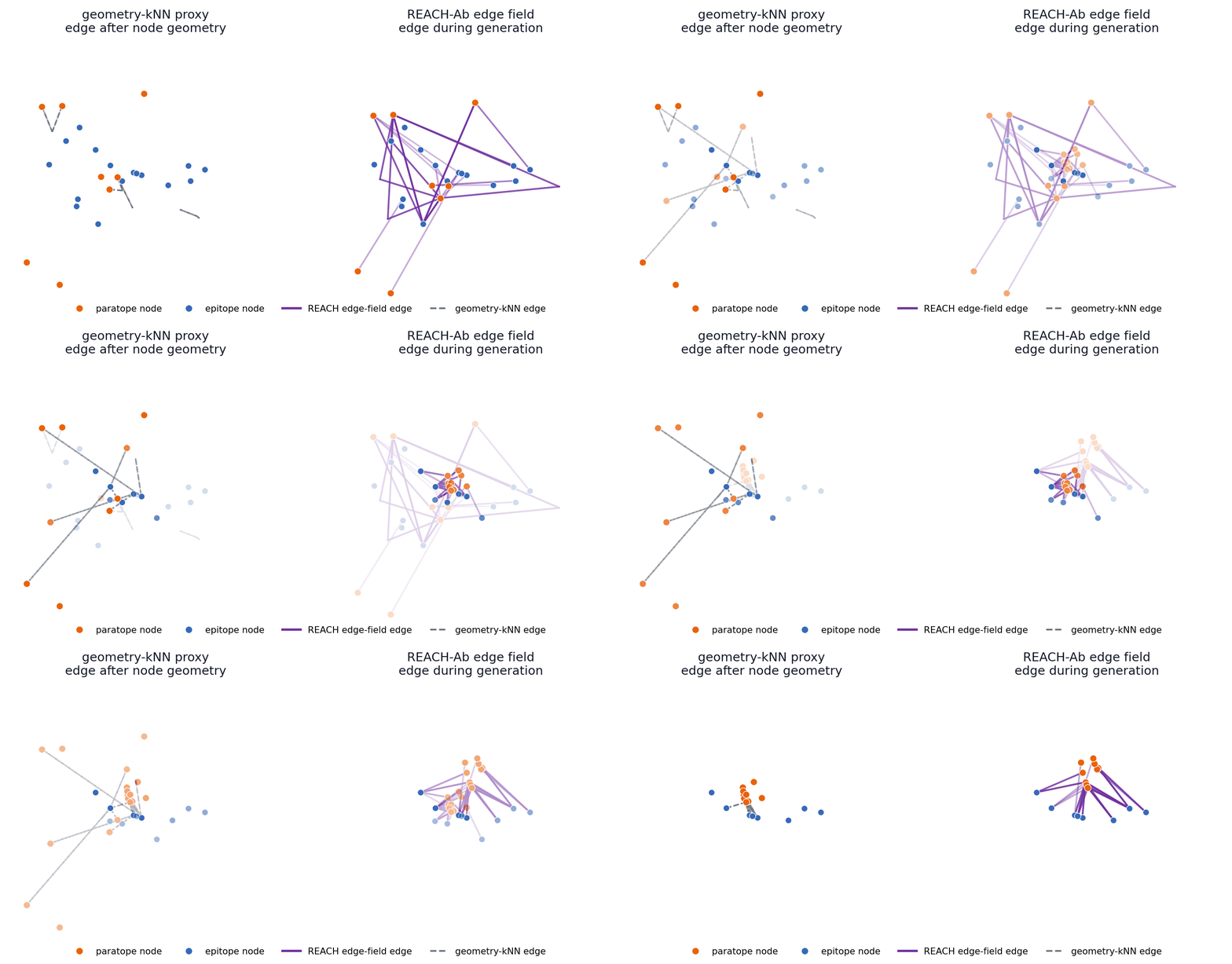
The main-paper mechanism claim is temporal: REACH-Ab should expose useful epitope-paratope contact hypotheses before the final CDR geometry is settled. These 57 trajectories compare a geometry-kNN proxy with the REACH-Ab edge field for the same benchmark cases shown in the PDB viewer.

AAR - | LDDT - | DockQ -

Animated comparison of geometry-kNN proxy edges and REACH-Ab edge-field edges for 4FQJ

4FQJ edge-field trajectory

The left panel reconstructs edges after provisional node geometry appears. The right panel shows REACH-Ab maintaining and activating candidate edge states during refinement, so contact evidence can participate while the paratope is still being formed.

Paper to Code

Method equations linked to their implementation

This section merges the main-paper REACH-Ab method with the supplementary Model Architecture and Implementation Details and Theoretical Analysis. Each formula below is clickable: selecting it opens the concrete PyTorch implementation used by the current codebase.

Architecture Thread

REACH-Ab starts from a broad directed epitope-paratope candidate pool, encodes pair geometry and endpoint states, injects two-sided half-edge evidence, stores candidate-level memory, predicts lifecycle and uncertainty signals, then selects a sparse active interface graph for local message passing.

Theoretical Thread

The supplementary analysis explains why this matters: a broad candidate space preserves early contact accessibility, vector edge states are more expressive than scalar scores, half-edge probing generalizes one-sided scoring, and memory allows delayed activation from repeated weak evidence.